 Rev. William Ewart ("Billy") Daniels (1883–1940), and The Daniels Family
Rev. William Ewart Daniels, known to his family as ‘Billy’ or ‘Wncwl Billy’. He was born in March 1883, the son of a Weaver, John David Daniels who it is thought to have moved from Llanllwni to Clyn Glas, Cwmhiraeth in the late 1870’s to work as weaver. He married Margaret Evans in 1881, before moving to Oakford, Alltpenrhiw, Felindre sometime at the turn of the 20th century. John David Daniels is believed to be the son of John Daniel, i.e. John the son of Daniel. The Daniels’s were a large, proud, working-class family with strong socialist convictions.
Billy Daniels was born into poverty but despite his humble beginnings, he won a scholarship to the University of Cambridge. According to the late local historian Leslie Baker Daniels, he was one of the first if not the first to go to Cambridge or Oxford on a scholarship and became a renowned academic and clergyman. But there was something else about Billy, because he was a military man during the Great War of 1914-1918.
During the First World War, Rev. Daniels served as an Army Chaplain with the rank of Captain and spent approximately two and a half years on the Somme. Family accounts and newspaper articles state that he was exposed to mustard gas during his service, causing the respiratory problems that affected him for the rest of his life. Leslie Baker-Jones recalled seeing him walking from the family home, Oakford, into Felindre, often needing to stop to catch his breath.
His wartime service included Chaplain, Censor and Lecturer. In an extract from a diary which he wrote in 1937, he stated that during the War he was in France for 1 ½ years and Belgium for 6 months. He visited Holland, Switzerland and Ireland, but he also spent 1 year 1919-1920 in Germany during the Army Occupation. Further research may reveal whether this was connected with official duties, but the evidence suggests that it was, because he was a Cambridge educated Army Chaplain Censor with the rank of Captain in Germany during the Army occupation. The family are eager to find out more, because he didn’t speak about his army experience whilst alive.
First World War Censor
We don’t know exactly what Billy did, but in general a First World War censor was responsible for intercepting, reading, and altering private mail, press reports, and telegrams to prevent military secrets from reaching the enemy, stop espionage, and maintain public morale on the home front.
Censors performed several key duties:
- Redacting Soldiers' Mail: Both field officers and home-front postal workers opened and screened letters between soldiers and their families. They used black ink (or physically cut away sections) to hide details like troop locations, upcoming battle plans, casualty numbers, and the horrific realities of trench warfare.
- Controlling the Press: Censors monitored newspapers, films, and photographs, actively suppressing stories about military blunders, heavy losses, and German victories. In the UK, this was enforced through the Defence of the Realm Act (DORA), which allowed authorities to issue bans (known as D-notices) or shut down uncooperative publications.
- Catching Spies and Managing Intelligence: Thousands of censors, including bilingual women, monitored international telegrams and mail crossing into neutral countries. This allowed governments to intercept coded messages, catch spies, and gather economic data to enforce blockades.


Not much is known about his official duties during this time, but the family are intrigued to know more, because a Cambridge educated army chaplain with the rank of Captain Padre and a Censor, moving through formerly occupied territory to occupied Germany post war leads them to believe that there is more to this than meets the eye.
This caricature print of Rev. Daniels has only surfaced in recent years and was not known about in the family until around 2010. The family now believe that this caricature print of Rev. Daniels was commissioned by the satirical magazine Punch but was never published. It's not known how many prints were commissioned but this is the 19th print by an artist named TR Jones. The image depicts him in full military uniform, captains rank markings, wearing a chaplain's collar, and holding a Bible. He is standing on top of a wooden table, a further indication that he is preaching to the troops just behind the front line.

Rev. Daniels came from a large family with many brothers and sisters living with their parents John and Margaret Daniels initially it is believed at Clyn Glas, Cwmhiraeth before moving to Oakford, Alltpenrhiw sometime in the early1900's.
This is a list of family births and deaths, transcribed from a family bible by the mother of Mike Gibbon. Click on the image to enlarge.
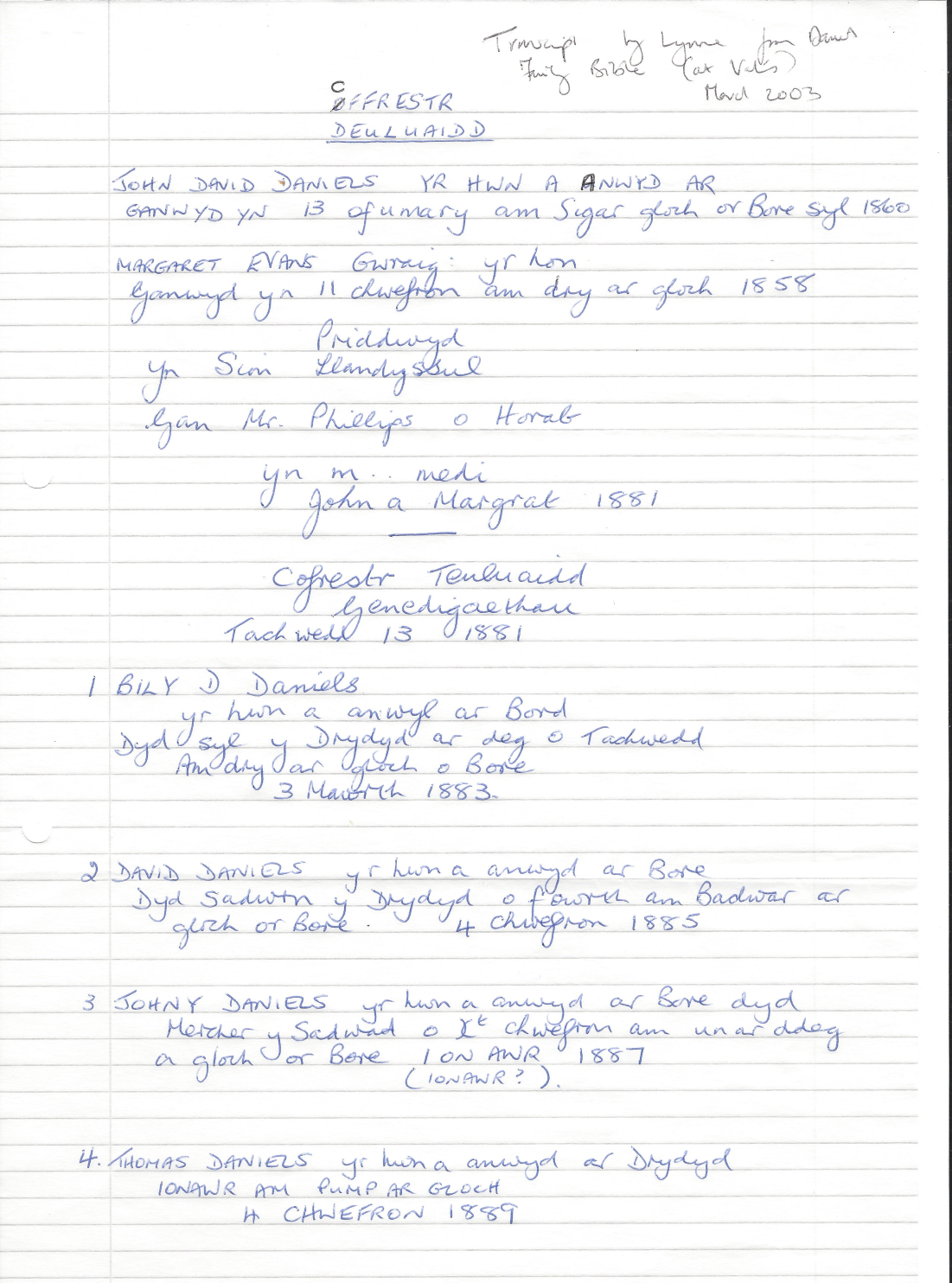
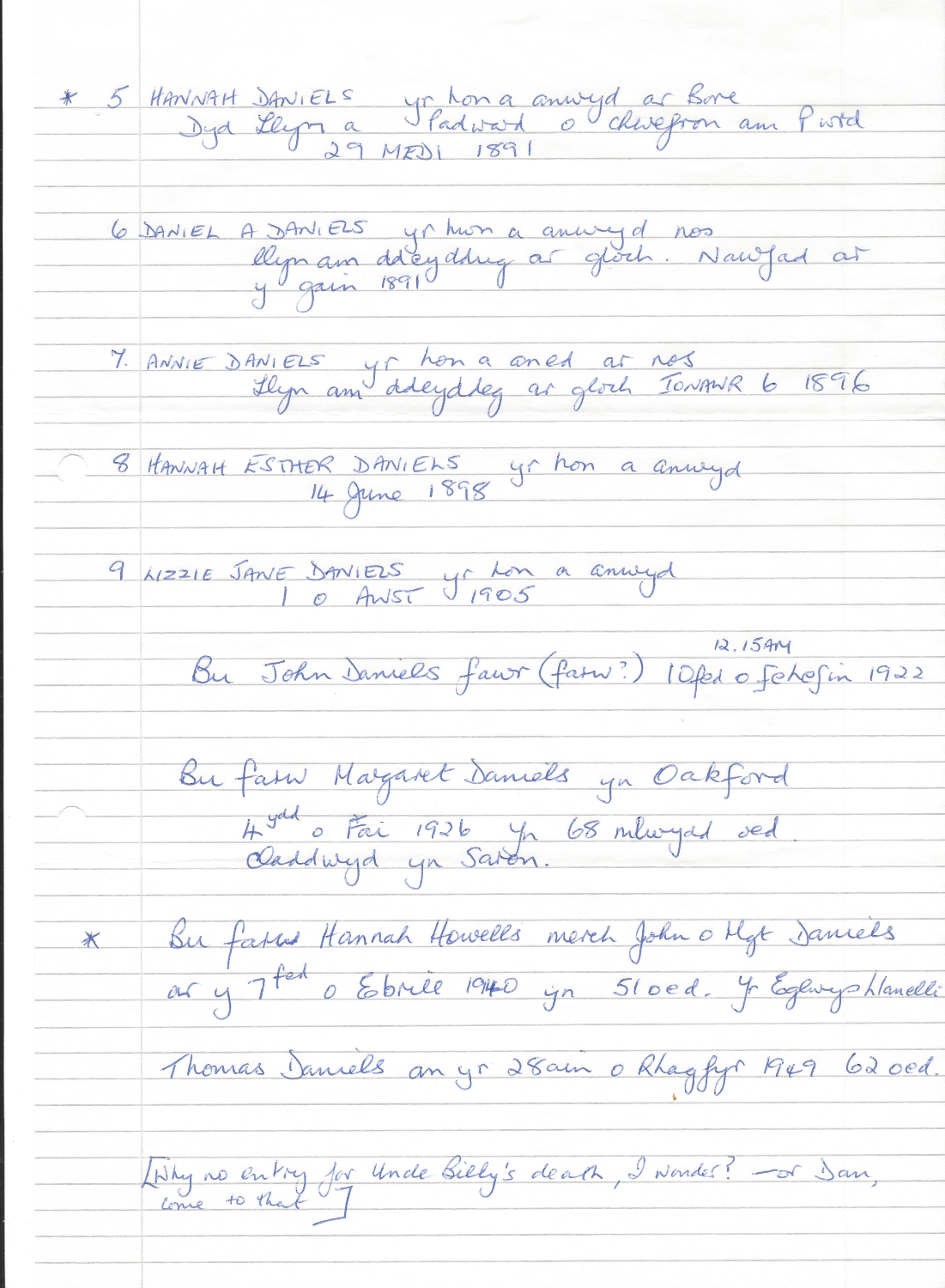
Siblings include Tom Daniels, another Somme veteran, and Johny Daniels both of whom remained at Oakford on the death of their parents. David ("Dafi") Daniels, who with his wife Lisa (Elizabeth) and family moved to Oakford in 1945, just as WW2 was coming to an end and until his passing in August 1969. His son William Daniels (Will) then moved to Oakford and lived there with his wife Beryl until his death in 1994. Oakford was the home base of the Daniels family not only for relatives who lived there or close relatives who lived nearby, but for those who had left to live in other parts of the country but always returned home to visit. Billy Daniels' influence on the family is obvious, but equally obvious the influence that the family had on him. The Daniels family came from an impoverished background, working class but aspirational as were the working class of the day. Leslie Baker-Jones said this about Billy Daniels name i.e. William Ewart Daniels like many others in the working class, named after William Ewart Gladstone (1809-1898), a prominent British statesman, Liberal politician, Prime Minister, and one of the most significant figures in 19th Century British political history. He was a hero to the working class celebrated for his moralistic approach to politics, his economical budgets, and his sweeping efforts to expand voting rights.
A long-standing family recollection tells how, while home on leave from the front, Tom was asked by Dafi to suggest names for Dafi's newborn twin sons. Tom suggested the middle name for one as Armentières, and the other Lehman after the honoured Lieutenant-General Gérard Lehman, the Belgian commander celebrated for the defence of Liège. Both names were used by Dafi, but whilst Tom was attributed to providing the name for Armentières, Billy may well have had an influence as well because family recollect it being said that he too might have been at Armentières. Naming one of the twins after Armentières would not have been unusual because the town is famous for the World War I Song "Mademoiselle from Armentières," an immensely popular marching song sung by Allied soldiers during World War I. However there appears to be no connection with the Lehman and Armentières. More importantly Armentières was infamous for Intense Trench Warfare. It was located on the front lines, and site of the Battle of Armentières in October 1914. Throughout the war, the town was heavily bombarded, becoming one of the first locations where poison (mustard) gas was deployed on a large scale. That may be the connection with Billy because he suffered from a Mustard Gas attack and was hospitalised near the battle front, before being shipped home. We are not sure where he was hospitalised, but he later settled and raised a family in Worthing and Sompting, in Sussex which would have had many military and hospital bases for returning troops in the first and second world wars. He suffered from ill-health throughout the rest of his life and although not recognised in documents was the main cause of his death which happened back home in Oakford in 1940 whilst staying with his brother(s), Tom, Johnny or both.
Several of these names, David, Tom, John, Jonny, Billy, Will, Armentières, Harry, Lehman, and even Daniel have carried forward as middle names in later Daniels generations.
After the War
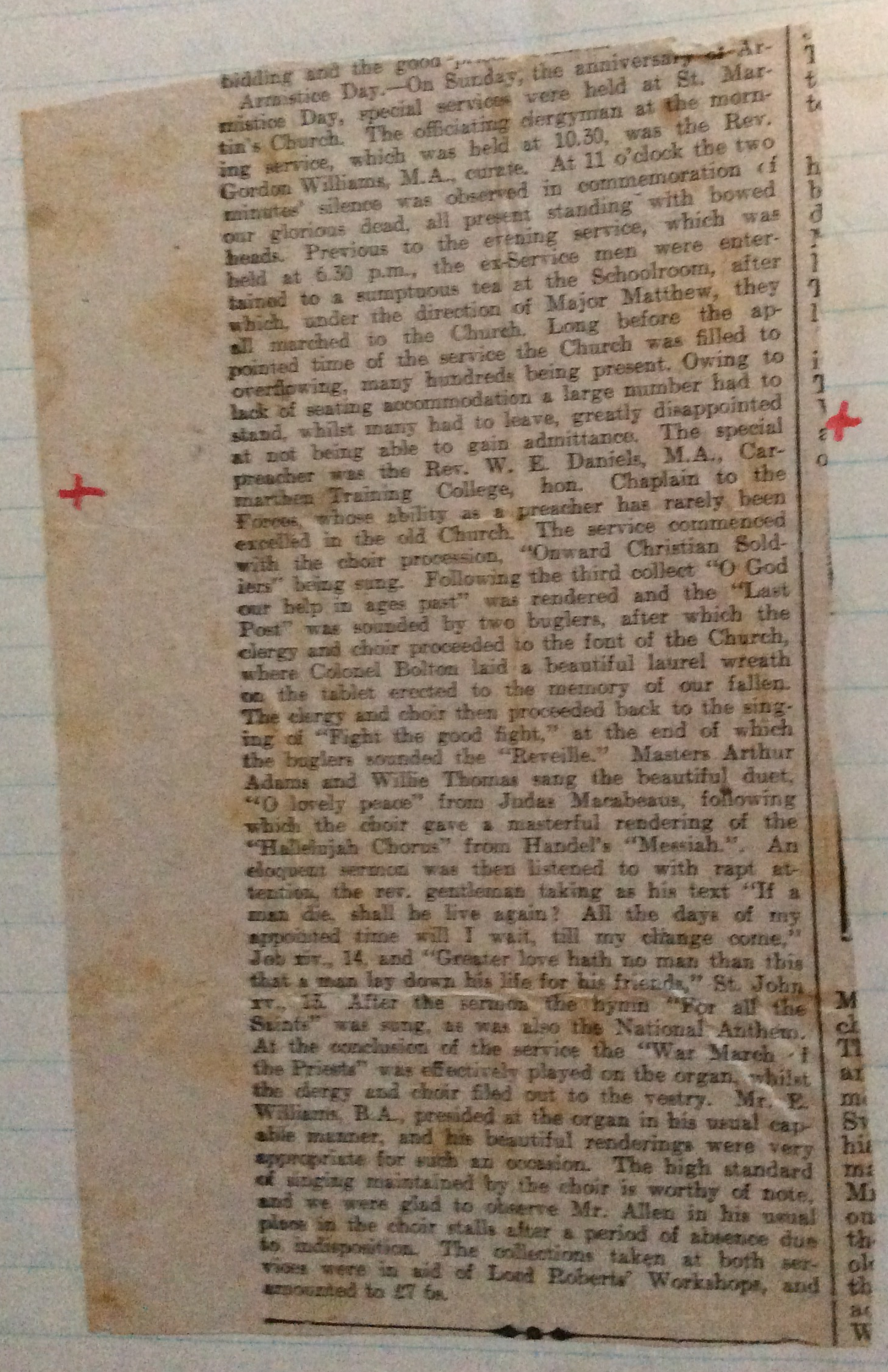
After leaving the army, Rev Daniels became the Chaplain and a Tutor at the South Wales and Monmouthshire Training College (which was renamed in 1931, Trinity College, Carmarthen). He was Honorary Chaplain to the Forces Remembrance Day events as reported the newspaper clipping (click on image) which he cut out and kept in his diary.
He married in 1927, which was reported in the Western Mail on Saturday 4 June 1927.
CHAPLAIN'S BRIDE DAUGHTER OF FORMER MAYOR OF CARMARTHEN.
The wedding took place at St. Peter's Church, Carmarthen, of the Rev. William Ewart Daniels. M.A., LL.B., tutor and chaplain at the South Wales Training College, Carmarthen, and son of Mr. and Mrs. John Daniels, Oaksford, Velindre, Henllan, to Miss Florence Mary Arthur, only daughter of Mr. J. B. Arthur, J.P., of Elm Lodge, a former mayor of Carmarthen, and the late Mrs. Arthur. The Rev. Canon B. Parry Grittiths, M.A., R. D., vicar, assisted by the Rev. J. L. J. Davies. M.A., curate, officiated. The Rev. E. Basil Herbert, M.A. LL.B., Carmarthen, was the best man. The honeymoon is being spent in London and Bournemouth.
In the 1930s the Rev. Daniels settled in Worthing, Sussex, where he was Curate of St. Luke’s, Brighton and then Vicar of Sompting, Sussex. He also lectured at Brighton, Haywards Heath and Eastbourne, under the Church Tutorial Association.
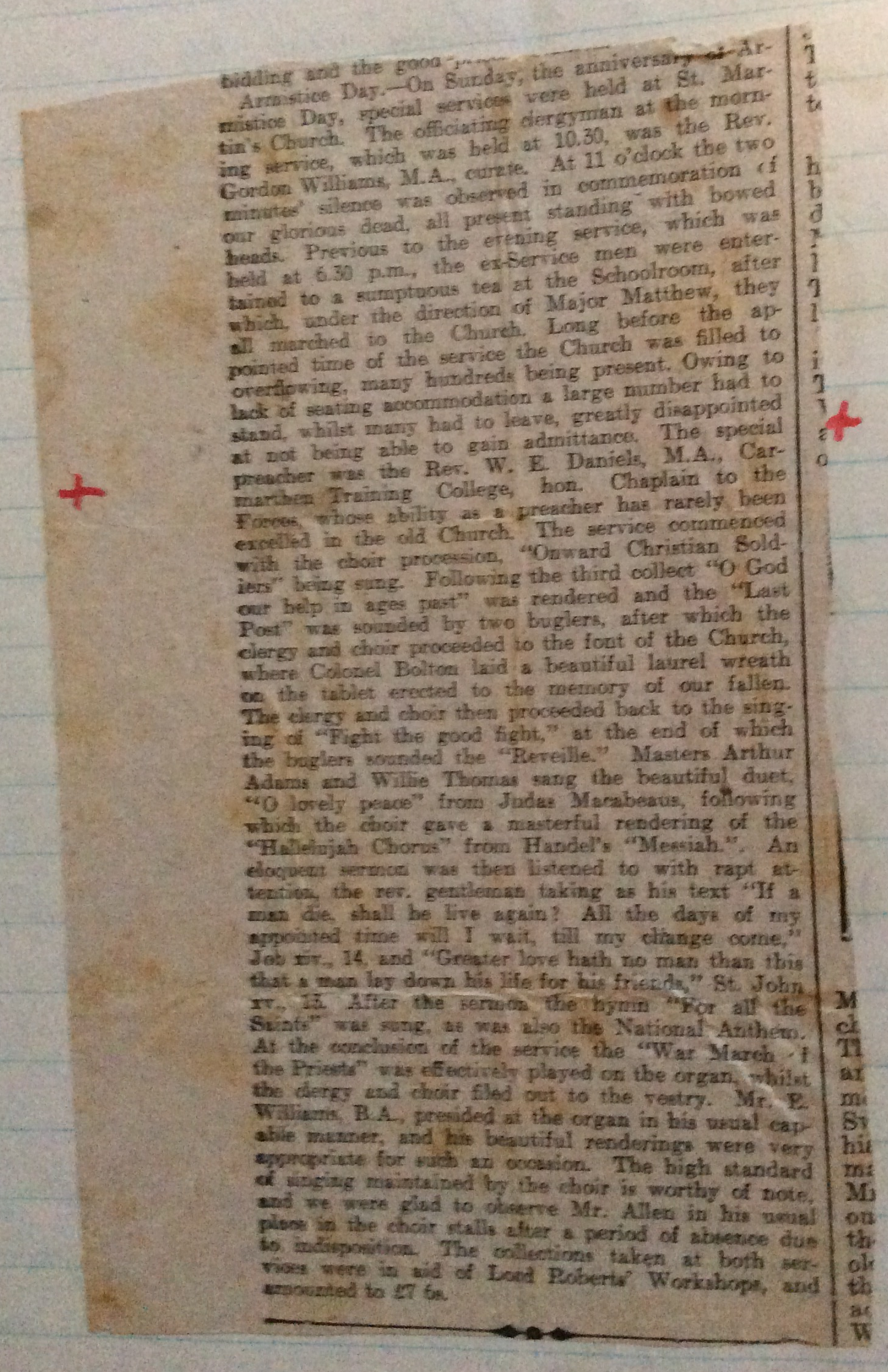
Worthing Herald – Saturday 7 December 1935
DOGGED BY PERSISTENT ILL HEALTH
The Vicar of Sompting, the Rev. William Ewart Daniels, has resigned the living. Almost continuously since he was inducted to the thousand-year-old church by the Bishop of Chichester on December 17, 1932, he has been dogged by ill-health. At one time he was given leave of absence for some months, and he went to Switzerland in an effort to recover. It was unavailing, however, and recently Mr Daniels had another serious illness. His decision to retire is dictated by his health. In his three years as vicar Mr Daniels has made himself genuinely well-liked in his scattered and fast-growing parish and will regret that he finds it necessary to resign. Before he to Sompting Mr Daniels was for about three years curate of St Luke’s, Brighton. It is understood that Mr Daniels will not leave the district, but will live with his family at Lancing.
From the “Who’s Who in Worthing and District”
DANIELS, Rev. William Ewart, B.A. (Wales), M.A. (Cantab), LL.D. (Dublin). s. of John Daniel, of Velindre, in Carmarthenshire. m. Florence Mary, d. of G. B. Arthur Esq., J.P. In temporary retirement due to ill health. Formerly Chaplain and Tutor at South Wales and Monmouthshire Training Coll. Curate of St. Luke, Brighton; Vicar of Sompting. Sussex, 1932-36. Lectured in Sussex at Brighton, Haywards Heath and Eastbourne, under the Church Tutorial Assn. Corresponding Tutor at Burlington House, Cambridge. Contributed number of articles to the Welsh Biblical Dictionary. Served during Great War for two and a half years as Chaplain, Censor and Lecturer. - The Cottage, North Lancing.

Diary
The Rev WE Daniels diary is in the safe keeping of his grandson Tim Daniels who along with his sister Sally granddaughter of WE Daniels, are both still living in Sussex. Both have contributed to this account, and like other family members are keen to know more about their grandfather, particularly what he did in WW1. Click on the photos, to enlarge.
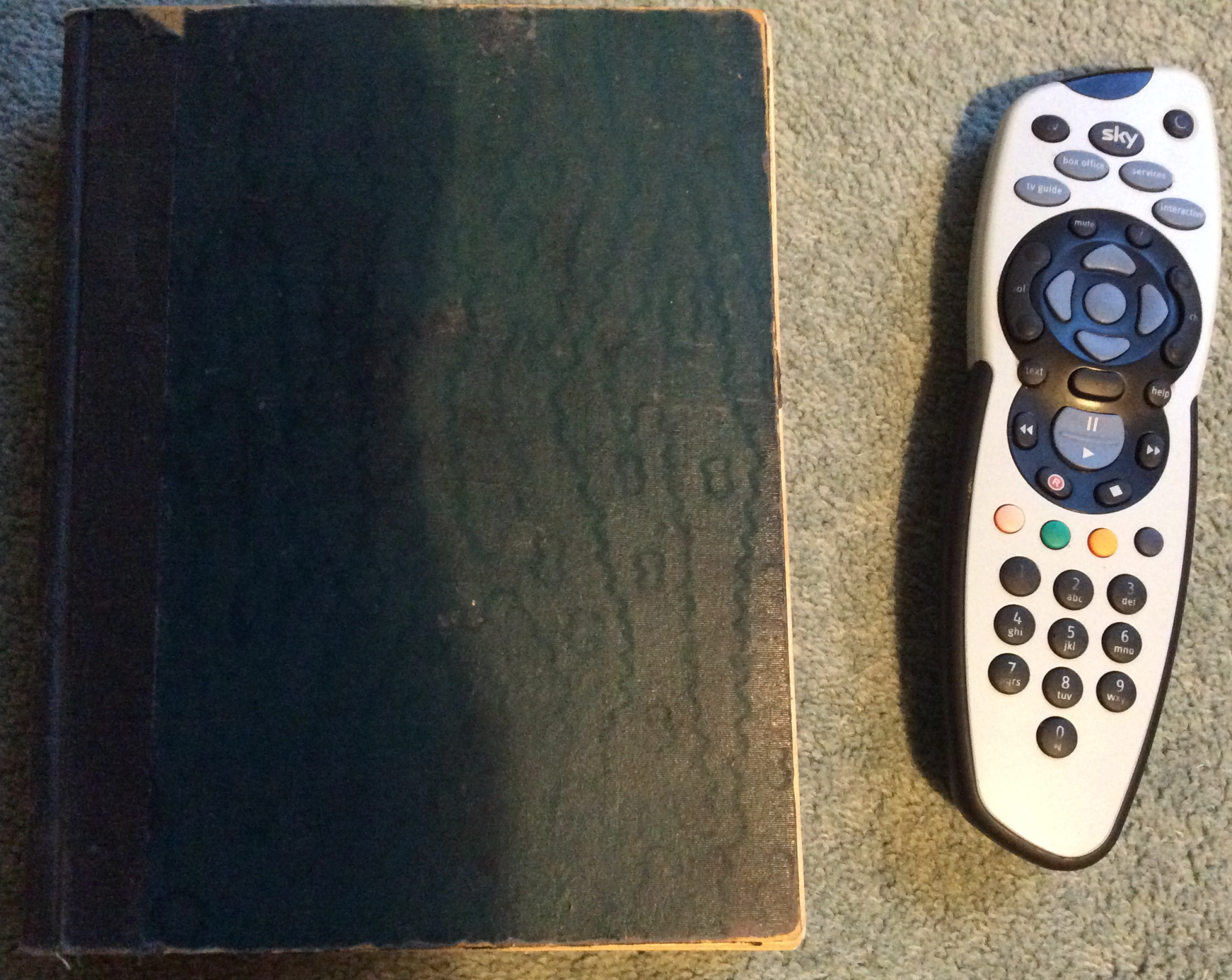
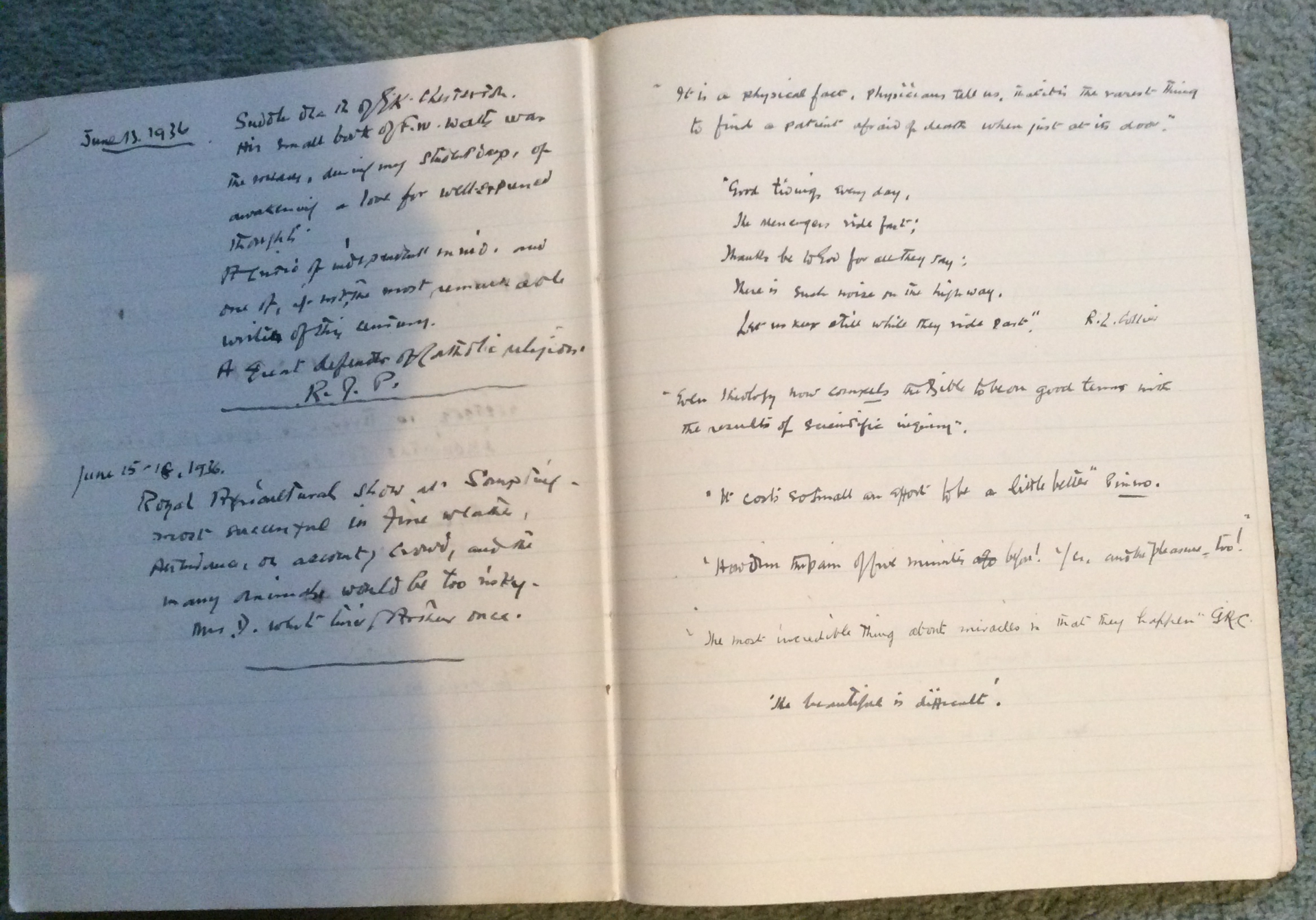
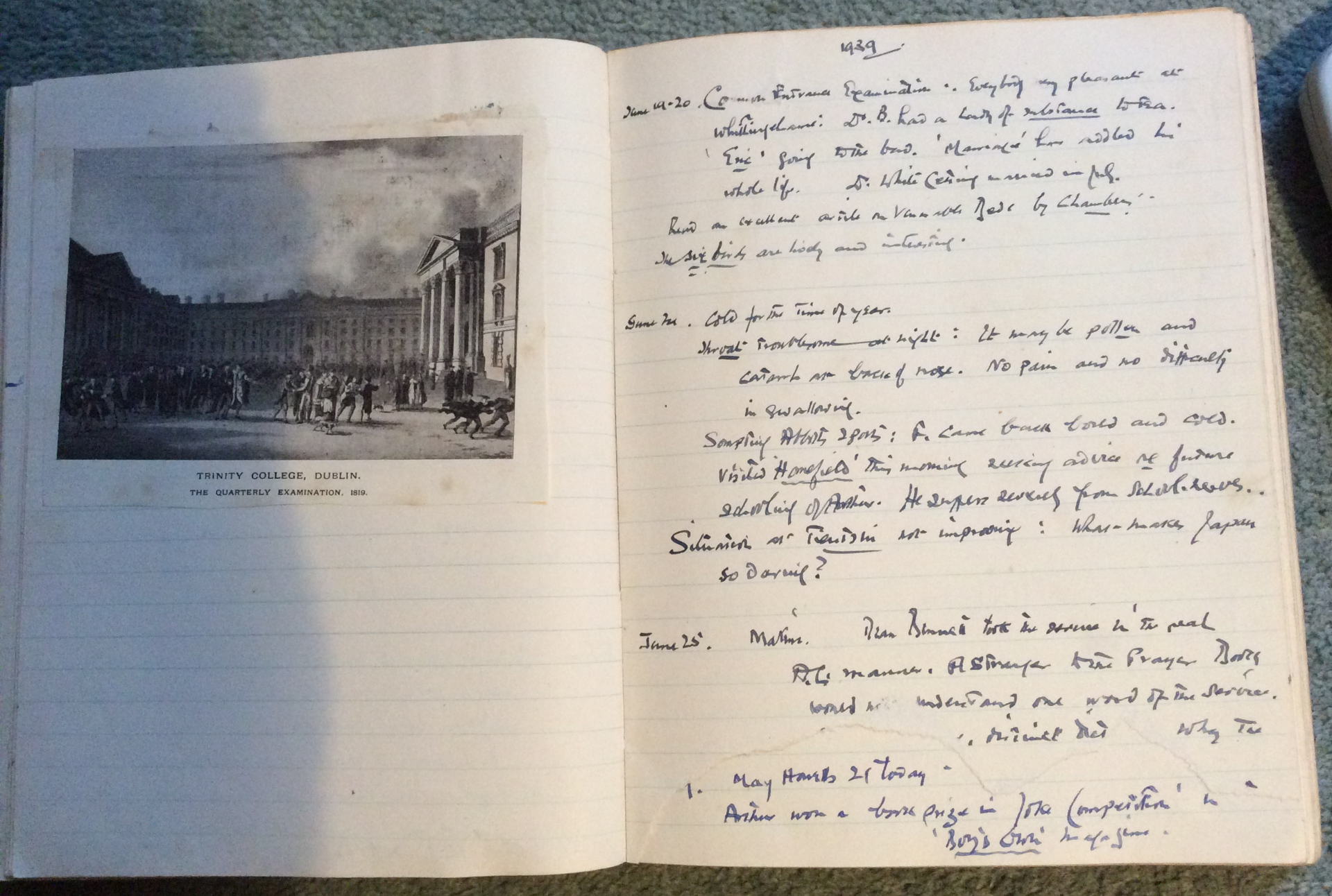
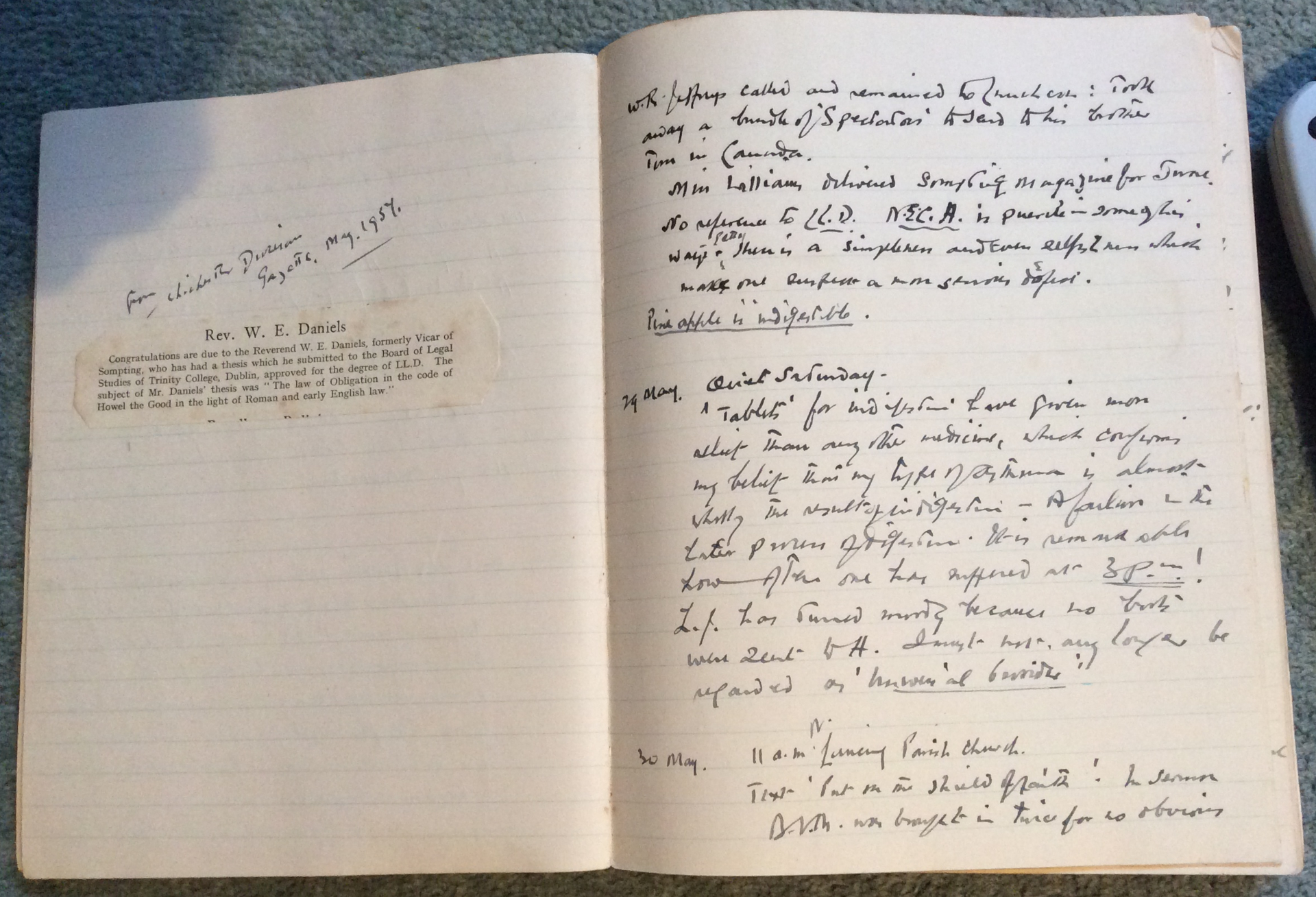
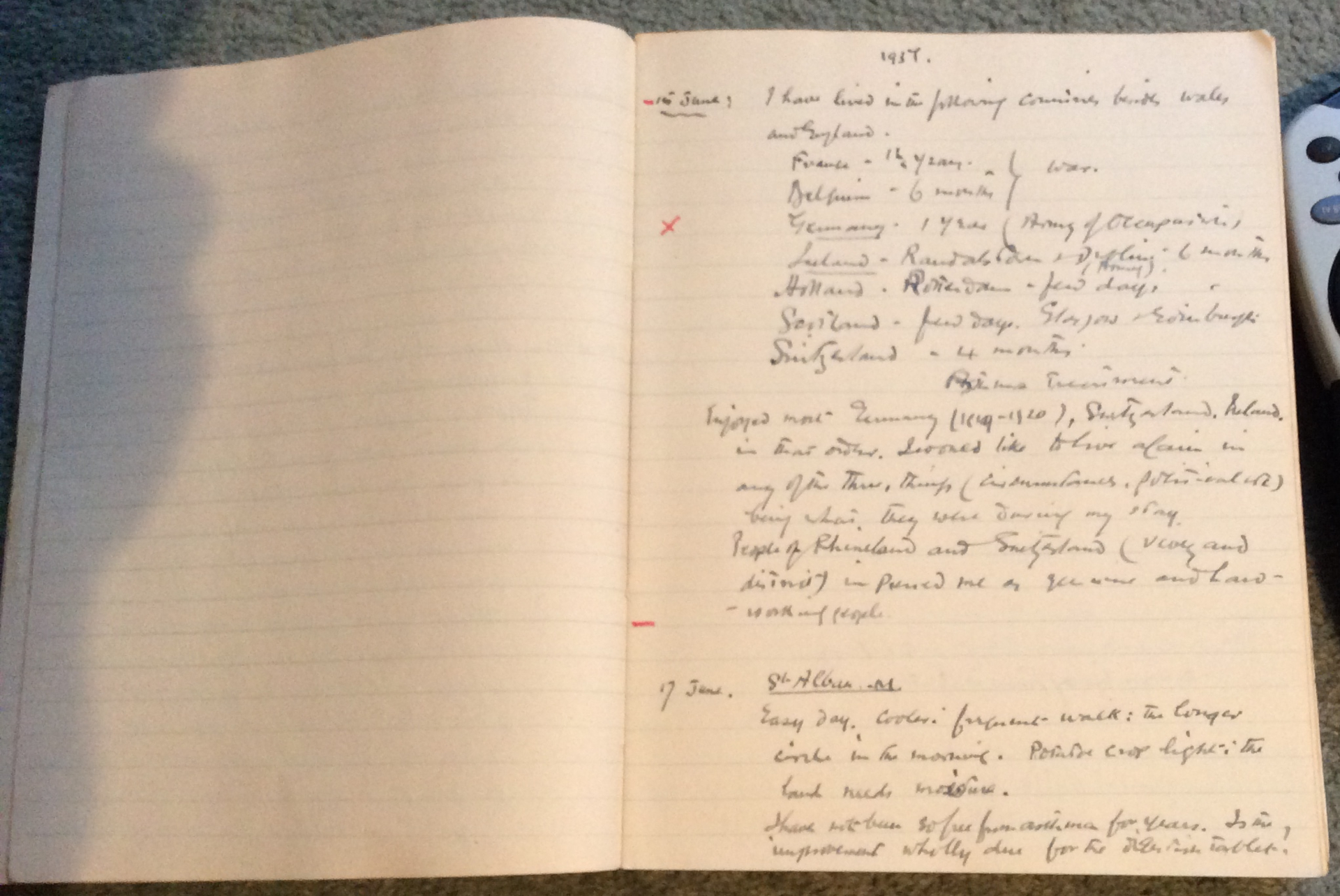
The diary includes accounts of him on first going to Cambridge and being ridiculed for his Welsh accent and Welsh ways. Similarly, there are accounts of him being derided by senior Army officers during the great war. The family believe that this is in keeping with his socialist working-class roots in conflict with the elite, which is the Eton educated type, so called elite.
Academic books from the Rev. Daniels's library are still in the family, many bearing his signature. They include:
Classical handwritten texts on the classics, Greek and Latin
Two copies of the small prayer book “WITH THE COLOURS FOR GOD, KING AND COUNTRY. PSALMS AND HYMNS FOR SOLDIERS IN THE FIELD” 1916
Click on the images to enlarge.
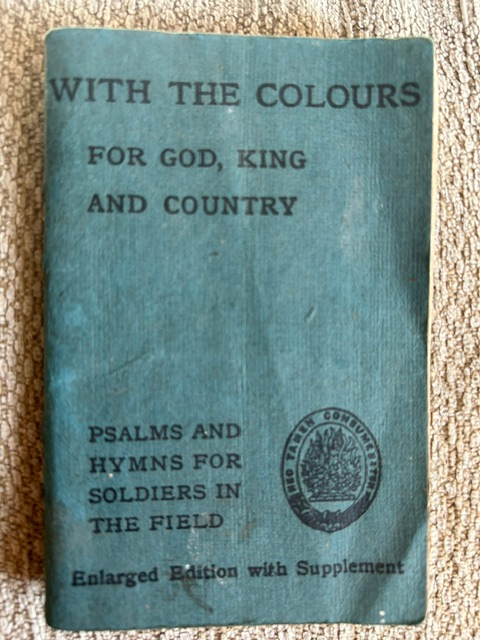
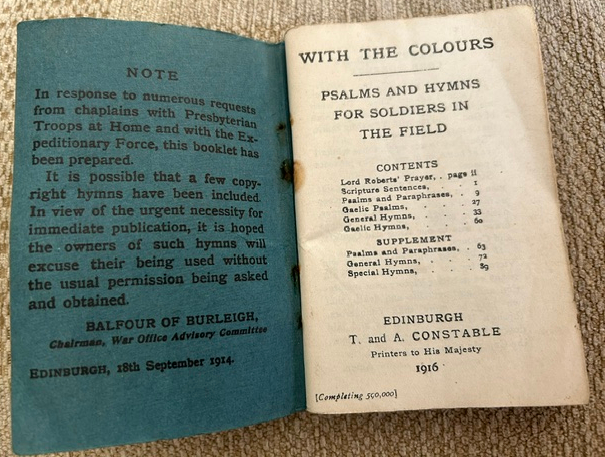
This provides a tangible link to both his academic life and his wartime service.
There were also a German Dictionary and German Phrase Books that are sadly no longer in the family’s possession.
Other family items
The family recollects at least one bullet cartridge probably for a pistol kept with his academic books, and very likely to be Billys because he was an office and probably issued with a pistol, whereas Tom was an Infantry Man was not.
Set of Golf Cubs which seemed very old, even to a child in the early 1960’s. They are no longer in the family’s possession but were probably from the turn of the 20th century. They could only be Billy Daniels clubs, because although they didn’t know if he played golf, no one else in the family played golf, and he did mix with academics, and the officer class so were surely his.
A delicate Porcelain Ornament from Holland is thought to have been brought back Holland by Billy, but fell off the mantlepiece, broke and was beyond repair. It had a winding mechanism and played a lovely tune thought to have been Tulips from Amsterdam. However, this song was composed in 1954, years after his death. The family may be mistaken in their recollections, or mistakenly thought that the tune was Tulips from Amsterdam.
The family think that of the two books for soldiers in the field, one was Billy’s and the other Tom’s. One is now with Tim Daniels (Grandson) in Sussex, and the other with Stephen Jones (Great Grandnephew) in Felindre. The link between Billy Daniels, the Daniels family, from Felindre and Sussex remain.
This a transcription from the Family Bible with the names and dates for the family of John and Marged Daniels. Click on the images to enlarge.
Another Family Bible for David (Dafi) and Elizabeth Daniels (Oakford) and family including names Trevor Armientierres, Harry Lehman, Dilys, Hetty Jane, Daisy, Will, Davey John, Morfydd, Annie, and Glyn Daniels. Sadly, all the family have passed away except for Glyn the baby of the family but now 97 years old who was in the Airforce doing national service before returning to Pembrokeshire where he was a Policeman for 30 years. Now living in Kent close to other family members in the South East – From Felindre to the South East but Daniels and Felindre through and through, all tied up with work, war and movement because of both WW1 And WW2 which seems to be the Daniels family and WE Daniels story.
Grave


Rev. William Ewart Daniels died on 16 November 1940, aged 59, and is buried at St Barnabas Church. The inscription on his gravestone
THANKFUL REMEMBRANCE
OF THE REV. WILLIAM EWART DANIELS MA LLD
OAKFORD VELINDRE
LATE VICAR OF SOMPTING WORTHING
WHO DIED NOV 16 1940
AGED 59 YEARS
DY EWYLLYS DY A WNELER
Picture with the cross in the foreground is the grave of the late Rev WE Daniels. The 3 black marble graves in the background are Daniels family graves of
- Dafi Daniels and family of Oakford
- Annie Muriel Daniels Jones and her Husband Douglas Charles Jones
- William Edward Daniels
The Daniels Family
Whilst Oakford was a place of joy, where family from far and wide would always come back to, it was also a place of sorrow, because that’s where, Will Daniels was brought home when he died in 1994, where Dafi his father died before him in 1969, and another of Dafi sons Davey John in 1962, wife Lisa in 1961, and their daughter Dilys died in 1946. William Ewart Daniels died at Oakford in 1940.
Whilst uncles were referred to by their first names as Tom, Johny, Dan etc, Billy was always referred to as Wncwl Billy with a slightly different gentler tone of reverence. This was the same tone for Dilys who was always referred to as Dilys ni (our Dilys) who was a devout Christian.
Dilys Daniels was the daughter of Dafi and Lisa Daniels (formerly Cloc y Groes, Drefelin) brought up in the family home of Rose Villa Drefelin. The family moved to Oakford in 1945 just as the war was coming to an end, but Dilys had moved to London and trained as a nurse on a TB ward at St Pancras Hospital. She was not alone in London because her sister Hetty Jane was up there as well as Davey John her brother and from time to time would meet up with Harry (Leman), and Trevor (Armentieres) who were both in the Airforce. There is a photograph in the family of all three in the garden at Rose Villa with the twins presumably on leave from the Airforce either side of Dilys who had not yet left for London or was on leave from the hospital. The family recount that Dilys was trapped for 3 days when St Pancras Hospital received a direct hit during the Blitz from a high-explosive bomb causing significant destruction. Dilys recovered but sadly towards the end of the war she contracted TB on the TB Ward where she was a sister. The twins commandeered a Military Ambulance and went to St Pancras to bring her home to Oakford where she died in 1946 surrounded by grieving family. There is a picture of her, with certificates for Sister Dilys Daniels in the Treatment of Tuberculosis, and another certificate, her death certificate with the cause Tuberculosis.
Hetty Jane was working in Service with a wealthy London family from the start of WW2. She met Ernie Robinson a soldier in the Durham Light Infantry, got married and settled in South Shields. It was the toss of a coin that settled it, Wales or the NE; Ernie won. They had three sons, Billy (named after Wncwl Billy Daniels), Brian, and Trevor Lehman Robinson. Trevor after Trevor Armentieres and Lehman after Harry Lehman the other twin.
Billy and Brian, and Hetty Jane were evacuated from South Shields to Rose Villa Drefelin in 1942. Brian used to say with a cheeky grin that he had problems as a child because when he came down to Wales, he couldn’t speak a word of Welsh, but when he went back to the North East in 1945, he couldn’t speak a word of English. Both could speak fluent Welsh at the time but even in later years their Welsh pronunciation was perfect in amongst a broad Geordie accent. Billy sadly died in July 2026, but in a conversation with Stephen Jones his cousin, said that living at Rose Villa was the happiest time of his life, people were so kind to us etc, then he would reminisce about going past Danwaring, up the path to Alltpenrhiw to Oakford, then go to the Bargod to fish or across the ddol (meadow) to play snooker in the hall where Marged Trefecca was caretaker. Welsh names amongst a broad Geordie accent just like his mother Hetty Jane who spoke immaculate Welsh, but would say to her husband Ernie in Geordie, sorry Ernie but I have to say this in Welsh, it doesn’t sound the same in English. Hetty Jane, and Ernie, always came back every year until the early 1970’s, and Brian and Trevor were forever coming down to Wales well into the 2000s; sadly, no more.
Account by Stephen Jones (Post), Great grandnephew of WE Daniels
I learnt of Uncle Billy Daniels as a child spending most of my weekends and all holidays including all Christmases at Oakford, where relatives would come from far and wide and reminisce. As a child I played in the woods at Alltpenrhiw, fished on the Bargod in the meadow below, and played in the house. I was intrigued by the front room parlour (parlwr) because of the books stacked high, the golf clubs, the bullets and the cartridge and the German Books. I searched high and low for the pistol but couldn’t find it anywhere, and nobody told me it wasn’t there. Later it was made into a bedroom for my grandfather (Data); even by aunts and uncles called him Data. Known as Dafi, a hard worker who had several jobs in his time as a collier who still found time on weekends to work on a farm, tend to the large vegetable garden and go poaching, not for sport but to put food on the table for his large family.
The information provided is mainly from recollections of what I heard as a child with information I learnt as an adult, family air looms and information provided by distant cousins who contacted me on seeing the Stori Fawr website. I collected the information whilst being the chairman for Stori Fawr Drefach Felindre 2013 – 2016 with the intention of putting it on the website years ago, but at the time I was consumed with the project and website set up along with collecting and publishing material on the website that was coming my way from other contributors like Bargod Rangers. Why wouldn’t I? I followed Bargod from an early age with my mother Annie Daniels Jones. When I was a player, she was the club’s president in 1987-88, and my grandfather Dafi Daniels was Life President of the club from the 1950s. Tommy Lleine a formidable centre forward and had married my cousin Nesta, Aunty Daisy’s daughter who lived at Maesteg next door to Oakford. They moved to Luton in 1969 but always came back with Gary and Gaynor. When the first moved to Luton they went into a local museum to shelter from the rain and saw a 1897 Eisteddfod chair for Felindre. Nesta helped us tracked find the chair about ten years ago and it was put on display in the National Wool Museum.
I should have added all our family and social history to the Stori Fawr years ago, so with apologies to my family here we go. I’ll update the information if and when new information comes in for Uncle Billy, and I’ll add to the information below on the Daniels family and the village post office where I was born and bred, and where my mother was the village postmistress for 38 years from 1953 to 1988, (my father postman), and when I was the Postmaster from 1988 - 2000.
Annie Muriel Daniels Jones 1924 to1988. My mother, daughter of Dafi Daniels, niece of Billy Daniels, and village Postmistress from 1953 – 1988. Prominent within the village not only as the postmistress but because of her membership and tireless work for St Barnabas Church, the Mothers Union, the Women’s Institute, Bargod Teifi Mixed Chor, Bargod Rangers Football Club, and Felindre Branch of the Labour Party. Leslie Baker-Jones said she had a brilliant mind but not the opportunity afforded especially to young girls at that time. Professor Gareth Crompton was in the same class as her and LBJ and said no one was as good as Annie. The family meant a lot too her, so much so that she retained her maiden name. I have often felt that I should have done the same, but I called one of my daughters Cerys (to love), and Ann after Annie, and I called my son Daniel after her or maybe the Daniels family. It seems to have gone full circle because the first Daniels to Felindre was John Daniel i.e. John son of Daniel and I called my son Daniel
During the war Annie was a member of the British Red Cross and worked in the Food Office in Newcastle Emlyn. At the end of the war, she worked with scientists on ballistics projects at the MOD Aberporth. She could have trained as a scientist because she had a sharp mathematical brain and was well thought of at the MOD but the family could not afford to send the children to university apart from one Harry Lehman, who became a pharmacist in charge of all the Cardiff hospitals.
Sadly, Annie’s time at Aberporth was cut short, when she, like so many others at the time contracted TB, just like her sister Dilys, and later her sister Morfudd. Annie and Morfudd spent 2 years in isolation at Llanybydder Sanatorium before coming home to Oakford. Annie married my father Douglas Jones (Doug Post) from Kidwelly in 1953. He had been a gunner in the Royal Artillery during the war. Morfudd married Alun Havard, who was an army soldier and spent most of the war in India. Morfudd was the matriarch and go-to person in the family but was with you before you had time to ask. She was also a sister in another sense of the word, Sister Morfydd Daniels and Sister Tutor, like her sister before her, Sister Dilys Daniels.
St Barnabas Church meant a lot to my mother and the family, and she would attend most if not all services. I remember coming out of the church and walking towards the gate with my mother on a sunny Sunday when I would only have been about 8 or 9 years old, (*about 1970), and seeing a middle-aged man and woman walking towards us. They were strangers to the village, because back then we knew everybody. The man stopped and asked my mother in a London accent if she knew Dilys Daniels, and my mother replied, "I'm her sister". He then asked, where is she living now, before my mother had a chance to explain that she passed away in 1946 and is buried here in the churchyard. I remember it being very poignant because he came to the church because she was very religious and often talked to him about the village church. He came hoping that she was still alive, and when my mother explained I distinctly remember him replying with a sigh, "She was my first love". I went home, and my mother took them to the graveside.
My cousin Billy (named after Billy Daniels) from the North East died recently in July 2026, but he spoke to me often on the phone particularly about the family and Felindre, and Ive included it in this account. At the time of writing, I along with other cousins have planned this week to visit the last of the original Oakford Danielis’s and baby of the family at the grand old age of 97, my Uncle Glyn Daniels who now lives in Kent with his wife Meriel.
Acknowledgments
The information for this document has been provided by Stephen Jones, first Charman of Stori Fawr Dre-fach Felindre, from recollections of Daniels family conversations, family air looms, official documents, and publications, and with the grateful assistance of
- Tim Daniels, Grandson of WE Daniels
- Sally Daniels, Granddaughter of WE Daniels
- Mike Gibbon KC – Great Nephew of WE Daniels
- Glyn Daniels – nephew of WE Daniels.
- Leslie Baker-Jones, academic, local historian, and family friend
- Lesley Parker Solutions Factory – Stori Fawr Website co-ordinator
To be continued.
Stephen Jones
17th July 2026