AN AFTERNOON OF REMEMBRANCE
AT ST BARNABAS CHURCH, FELINDRE
Saturday, 27 June 2026.
Following the success of the Open Afternoon at Penboyr Church in 2025, the Stori Fawr Dre-fach Felindre group held a Day of Remembrance at St Barnabas Church on Saturday, 27 June 2026.
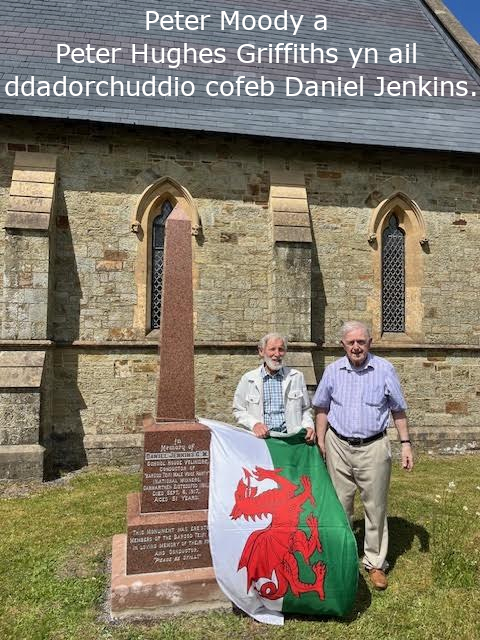
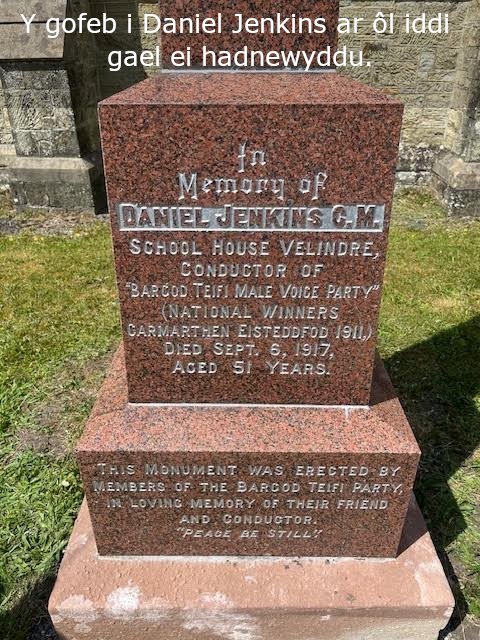
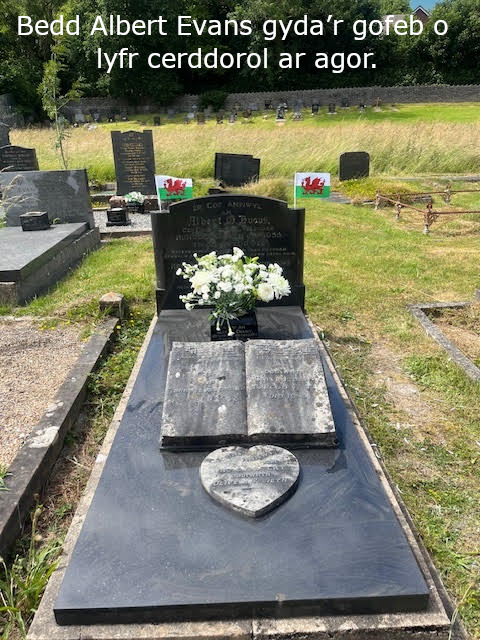
Special attention was given to the two most distinguished musicians produced by the area, both of whom are buried close to the main entrance of St Barnabas Church. As the memorial to Daniel Jenkins had become unstable and its inscription had deteriorated over time, members of the Stori Fawr group arranged for the memorial to be restored, with the intention of unveiling it once again during the event. The programme also included a visit to the grave of Albert Evans, the other renowned local musician.
Programme for the Afternoon:
2.00 pm – Mari Elin gave a talk in the church about the history of St Barnabas Church, followed by Gwenno Mai, who spoke about Penboyr Primary School. Peter Hughes Griffiths then presented a short history of the two musicians, Daniel Jenkins and Albert Evans.
The restored memorial to Daniel Jenkins was officially re-dedicated by Peter Moody, former Chair of Governors of Penboyr School and one of the church wardens.
The afternoon concluded with tea and cakes at Penboyr School. Around sixty people attended. Lesley Parker prepared and presented the images shown on screen to accompany the talks, and simultaneous interpretation was arranged by Aled Eynon. Among those present were Eirlys Griffin, granddaughter of Albert Evans, together with two of her sons.
It was a very successful and enjoyable afternoon.
The following pages contain the talks given by Mari Elin, Gwenno Mai and Peter Hughes Griffiths.
A Glimpse at the History of Saint Barnabas
by Mari Elin Jones
At the beginning of the nineteenth century, the locals in the area worshipped at Trinity Chapel, or the Capel Bach as it was called, down by the Bargod riverbank next to Felindre before crossing over to Dre-fach. This was a chapel of ease which belonged to the Parish Church, Saint Llawddog - it was a more convenient place than walking all the way up to the top of Penboyr. The names of the houses built later near Pont y Capel are evidence of the chapel's former presence - Ywen-las, Maes-y-capel, Maes-yr-ywen, Glanywmor, Ffynnon Capel - the word "capel" or "ywen" or "yew" appears in every one of them. By the 1860s, the chapel had fallen into ruin. The population of both villages was growing with the expansion of the wool industry, and there wasn't a church nearby that was convenient to attend.

The Earl of Cawdor, a wealthy landowner, was ready to build a new church. The family originally came from Scotland, the Campbell family (they weren’t related to Macbeth – that was Shakespeare’s imagination!). Through marriages, they had inherited lands in west Wales. They lived at Stackpole, in south Pembrokeshire – Stackpole Court – and they owned land in the Teifi Valley. The Earl of Cawdor also paid for Cawdor Hall in Newcastle Emlyn, the hall where the clock is. And there’s Cawdor Garage and the former Cawdor Hotel.
The Carmarthen Journal says the Earl – who had been staying overnight in Llysnewydd – arrived in Penboyr Parish on Thursday, 13th February 1862, with the architect David Brandon, a notable architect from London, following him. The Earl went with the curate, William Harries, to look for a suitable place to build the church, and David Brandon went to inspect the Penboyr quarries to choose stones for the construction.
David Brandon was the chief architect of St David’s Psychiatric Hospital, Carmarthen – the Joint Counties Lunatic Asylum – which opened in 1865. As a member of the Quarter Sessions, the Earl of Cawdor had a legal responsibility in respect of the hospital – so it’s likely he knew David Brandon and consquently chose him to design this church.
The church was designed and immediately built for £2000. Considering the Earl lived in Stackpole, it’s not surprising he chose a builder from Tenby. The church has a simple plan in the Gothic Revival style of the 19th century – similar to other churches of the period – with a steeply pitched roof and stained timber beams in the ceiling, supported by timber couples on stone corbels. The external buttresses are decorative and also strengthen the walls to bear the roof’s weight: narrow pitched windows on each side and some larger ones at the back to allow more light, plus a polygonal rather than square chancel. Pembrokeshire slates were used on the roof and over the years many of them split and broke, and new slates were used when the church was renovated in 2017.
There are two things of particular interest in the building:
First, the bellcote – again in the Gothic style – carved wooden pillars support a spire and slates on top – very unusual for this part of the country and bigger than the bellcotes of other churches from the same period.
Daniel Jones said in his book on the history of the Parishes of Llangeler and Penboyr (Hanes Plwyfi Llangeler a Phenboyr), that it would be much better if there was a plain stone bellcote there like other churches in the area. Those are the bare bellcotes, much smaller, made of stone with a smaller bell, as seen from the outside – like Llangeler Church on the screen. St Llawddog’s bellcote, Penboyr – also stone but more striking in the Gothic spire style.


And secondly – three tall, narrow windows behind the altar depicting the Crucifixion, the Resurrection, and the Ascension. They were made by the company Heaton, Butler and Bayne from Covent Garden, London – one of the most famous and productive makers of Gothic Revival stained glass of the period. They are of exceptional quality – weaving the scenes together skilfully, the imagery is dramatic, and the patterns and subtlety of the colours blend together impressively. Two years after installing these windows, the company installed two tall, narrow windows in the nave of Westminster Abbey to commemorate the engineer Isambard Kingdom Brunel with scenes showing the building of the Temple and Christ teaching the people there.
There was a harmonium here initially. At the beginning of the twentieth century, an organ fund was established. Daniel Jenkins and Efan Powell were responsible, and £208 was raised, which is equivalent to £30,000 today. The organ was installed in 1914 and it was hand-pumped. In 1939, an electric blower was added, donated by the Dangribyn family.


Take a look at this church on the screen. This is St Paul’s Church, Bledlow Ridge, near High Wycombe, Buckinghamshire – very, very similar to St Barnabas! – and David Brandon was the architect. And the interior.


The Earl celebrated his birthday on June 11th, which is also St Barnabas Day. So that's the reason for the dedication. Barnabas was a companion of the Apostle Paul on his frequent journeys – and there are stained glass windows of both of them at the back of the church – given by the Lewes family, Dol-haidd. The Earl also paid to build Rhandir-mwyn church – the name? – St Barnabas of course!
This church was consecrated in a morning service on July 3rd, 1863, by the Bishop of St David’s in the presence of the Earl and thirty priests. The afternoon and evening services were in Welsh, and because of the large congregation, a platform had been erected in the graveyard, and there was an open-air service. The following Sunday, Reverend John Griffiths from Llandeilo preached again outdoors to a large crowd, and a report in Yr Haul, the church magazine, in August 1863, said that the witty vicar of Llandeilo delivered one of the most brilliant sermons ever heard; over two thousand people attended, and all the chapels in the area closed as a tribute to the famous priest who was born and raised in Llandyfriog.
The tradition of rural Welsh churches was low church. In fact, Reverend Sam Evans didn’t even light the candles during the communion service – just in case the Pope’s influence made a comeback!
During the golden age of the woollen industry Dre-fach Felindre was referred to as the Huddersfield of Wales. And like Huddersfield, music was very important here too. When Daniel Jenkins died in 1917, Thomas Morgan was appointed headmaster of the school because he could succeed Daniel Jenkins as the organist and choirmaster of the church.

As you can see, the St Barnabas choir consisted of male members only. In addition to the choir, the Band of Hope meetings used to be held at the school on Sundays. Mari Dafis and Tom Jones, Glanywmor, were the leaders, and the children would sing and listen to Bible stories


Apart from Sundays, preparations were made for three annual festivals – Calan Hen at the beginning of January at Llandysul church where the churches would recite from the Bible – this festival is still going. For the Whitsun Festival at Newcastle Emlyn, which has now ended, the combined choir of all the churches would have practised for weeks in advance in Henllan church hall. A Temperance Festival was established in 1917 but this festival has also ended! The church youth at the start of the last century were encouraged to sign the temperance pledge – this is my great-aunt's certificate, Hannah Jones, Goetre.
We have a number of lovely memories of the church as a family. Bernice Phillips was our Sunday School teacher. We remember the Sunday School Christmas party and dear Miss Phillips putting a spoonful of red jelly on one side of the dish and a spoonful of pink blancmange on the other, and then turning it swifty with a spoon before sharing it with everyone! My sister and I would enjoy helping mam-gu to shut the stops on the organ following the service! Dad remembers Viv and himself sitting in the stall under the pulpit over there – Sam Evans going into a trance in his forty-minute sermon and the spit flying over their heads. And my grandmother remembered Raymond Renowden playing a game by imitating his father, Reverend Charles Renowden. He lined his friends – both churchgoers and chapel-goers – in front of New Shop Inn, going from one to another with a handful of chippings saying ‘Eat this, eat this’. Raymond Renowden later became Dean of St Asaph Cathedral.
I’d like to finish by referring to my great-great-grandfather, Tom Jones, Glanywmor – a carpenter and undertaker – who repaired the bell tower in 1953. By now, the woodwork is in very bad shape again, and the bell has been taken to a foundry for restoration. It’s worth restoring, but it’s going to be very, very expensive, according to the forecasts – in the words of the Bible, ‘whoever has ears to hear, let them hear’!
A glimpse at the History of Penboyr School
by Gwenno Mai Jones
.jpg)
The Elementary Education Act of 1870 led to the establishment of state schools for children aged 5 to 12. Before that, only voluntary schools existed. Daniel Jones referred in his book on the history of the Parishes of Llangeler and Penboyr to a number of small schools in this area in the 18th and 19th centuries.
By 1847, according to the Government report on education in Wales – the Blue Books Report – four places were offering education here, namely Llangeler Church and Saron Chapel (Congregationalists) in the Parish of Llangeler, and Trinity Chapel (y Capel Bach) and Pant-y-bwlch Chapel (Methodists) in the Parish of Penboyr.
According to Daniel Jones' evidence, the Capel Bach was the main school in the parishes, being the oldest and the most consistently maintained. In 1751, the circulating school of Reverend Griffith Jones, Llanddowror, was held at the Capel Bach. The practice with those schools was to stay in a village for around three months, teaching people of all ages to read the Welsh Bible before moving on to another area – a successful policy of sharing knowledge. According to the historian, Professor Geraint Jenkins, Griffith Jones was the greatest Welshman of the eighteenth century, and we can take pride in the fact that he was born in Pantyrefail, Cwmhiraeth.
.jpg)
In the Capel Bach area on the banks of the Bargod river, the population was increasing. As my sister mentioned, the Capel Bach – a church establishment – was deteriorating in the 1860s, and St Barnabas Church had opened in 1863. The Earl of Cawdor was ready to pay for a new school, so a National School was established following the Church of England teachings to replace the Capel Bach and it opened in 1866 with 31 pupils. After the building was extended, by 1896 there were 311 children there according to Daniel Jones. Where they all found space, I don’t know!
Its original name was Felindre National School, but it was also called Penboyr Church of England School early in the twentieth century. With the Education Act of 1944, it officially came under the auspices of the County Council and then in 1953 it became Penboyr School, a Voluntary Aided Church in Wales School.
The schools of the National Society, like other elementary schools, focused on the three 'R's: Reading, Writing, and Arithmetic, and used a system of monitors, that is, older children acting as pupil-teachers, very similar to Griffith Jones’s circulating schools. Although all were Welsh speakers, English was the language of instruction, though there were the occasional lessons in Welsh (ambell i lesson yn Welsh, chwarae teg).
It was ironic that an Anglican school was serving these nonconformist villages. At that time, every family belonged to a church or chapel. In the school logbook for 1941, Thomas Morgan categorizes the children by denomination:
- 104 children in the school
- 16 were associated with St Barnabas
- 10 with St Llawddog
- 24 with Bethel Chapel
- 26 with Soar Chapel
- 28 with Clos-y-graig Chapel.
So three quarters of the children in the school belonged to the chapels.
Inevitably, there was tension at times between the two traditions. In the early years, teachers had to be churchgoers, and some believed that church children were favoured by the teachers! But according to the logbooks, there was no discrimination. Chapel children got time off school to attend their services and activities just like children from both churches did for their own activities. For example, the Soar Chapel Opera Company got free time to go to perform in St David’s. And Alderman Lewis from Meiros Hall was very involved with the school, sometimes allowing a day off for the children – and he was a Baptist.
John Evans, Singrug was responsible for the school's first months before Rees Rees was appointed headteacher before the end of 1866. We don't know anything about him apart from the fact that he led the choir in this church.
Daniel Jenkins came in 1892 with his musical talent. We can imagine that music was important in the school at that time. When Daniel Jenkins produced the cantata Golden Hair and the Three Bears in 1902, the school was closed for a whole week to practice. And when Daniel Jenkins sadly died in 1917, Efan Powell, Kirby House, was a teacher at the school and was a member of this church. He applied for the position, but Thomas Morgan from Llandysul, a musician and organist, got the job.
According to the logbook entries, Mr Morgan was quite the disciplinarian and not just with the children. Here are examples of his sharp tongue:
Copy book work in Standard 1 supervised by head - they are characterised by very dirty work and bad writing. Marking is not up to date. It is three weeks in arrears. Headteacher's absence is probably the cause of the slackness. Miss Davies must speak louder - children in the back cannot hear her. Advised teachers in middle room to reduce the din by half to enable work.
Evan Powell was finally appointed headteacher in 1946 following Thomas Morgan’s retirement.
Reports from government school inspectors – HMIs – and church inspectors over the years were written in the logbooks. The inspectors' reports generally praised the teaching.
It is interesting to note the comments of the Reverend T R Evans, vicar of Llandysul in the report on Religious Education in 1949:
A reading from St John's Gospel was given by John Griffiths, and Arwyn Jones recited Isaiah 55 - both did well, worthy of people very much their senior.
And later on in the report:
The young people - mainly boys were very responsive and able to express themselves intelligently. I may be allowed to mention John Vare in particular - a lad who showed unusual intelligence.
But if the education was praised, there were annual complaints about the condition of the building, the desks, and the chairs. The building was very uncomfortable when it rained and the children's clothes were wet from walking to school.
There were coal-burning stoves in the school. Tortoise stoves – named because they burned slowly – slow but sure! Leslie Baker-Jones remembered his class teacher, Efan Powell, in winter making the children run around the big tree by the river to warm up before coming inside in the morning.
In the 1940s and 50s, the condition of the building and the lack of proper toilets were a constant topic of discussion for the managers. Some thought that maybe transferring the school to the County Council would be an advantage, but Sam Evans, the Rector, was determined to keep it as a church school, and that’s how it stayed. It wasn’t until 1990 that the school was extended and remodelled. My sister and I remember going out to the toilets behind School House!
In addition to that which we read in the logbooks, interesting stories have been shared by former pupils along the years. Leslie Baker Jones remembered being taught through play in the ‘infants’, in the thirties, building with blocks and squaring clay – with some of the children eating the clay!
.jpg)
In 1938 Alwyn Dan-banc, Drefelin broke two small bones in his wrist while playing leapfrog in the yard, and Dr Jenkins tied his arm with a splint – a piece of wood from a box of Jaffa oranges – and Johnny Pen-lan-fawr, who owned a car, took him to the Infirmary in Carmarthen to put it in a cast.
The children were allowed a day or half a day off for all sorts of reasons – like the Newcastle Emlyn fair or the Cwm-pen-graig poultry fair for example – was very common. Farmers’ sons would get free afternoons during harvest time in the hope that they’d come to school in the morning.
One enticement for children to attend school was the food! Milk started being given to children in 1934, and in 1938 they could choose between milk and Horlicks! Lunch started in 1945.
.jpg)
.jpg)
There is a long and distinguished history of education in this village, and I am proud to say that I am one of the former pupils of Ysgol Penboyr.
These are theheadteachers of the school from the beginning:


.jpg)
Remembering Daniel Jenkins and Albert Evan
A talk by Peter Hughes-Griffiths
in St Barnabas Church, Dre-fach Felindre,
27th June 2026 at 2pm


It is wonderful that we have gathered here today to remember two outstanding musicians in the history of this area. Thanks to the Friends of the Stori Fawr Dre-fach Felindre website, and with the willing cooperation of the officers of St Barnabas Church, we have been able to restore the memorial to Daniel Jenkins, which also marks the resting place of his wife and two sisters. (Read about Daniel Jenkins on the Stori Fawr Dre-fach Felindre website.)
I, along with one or two others here today, am old enough to remember Daniel Jenkins' two sisters – Miss Jenkins Fowr ("Big Miss Jenkins") and Miss Jenkins Fach ("Little Miss Jenkins"), as we children called them. They lived in the house just above the Hall, next to John y Gwas's public house. Curiously enough, we children used to recite a rather cheeky verse about the two Miss Jenkinses! I'll happily tell it to you afterwards if you'd like to hear it!
So, who was this remarkable Daniel Jenkins, for whom the members of Bargod Teifi Male Voice Choir decided to erect this memorial beside the entrance to St Barnabas Church?
In my research I found two particularly valuable descriptions of him. The first appeared in the Carmarthen Journal in August 1911, after Bargod Teifi Male Voice Choir won the Male Voice Choir competition at the Carmarthen National Eisteddfod, and again following his death in 1917, when John y Gwas wrote about him.
The second comes from the book Yn Fore yn Felindre by Tom Davies, who grew up at Treale and recalled Daniel Jenkins from his days at Penboyr School. Daniel Jenkins served as Headmaster of Penboyr School from 1892 until his sudden death in 1917 at the age of just fifty-one.
I shall read only a few extracts from Tom Davies' chapter on Daniel Jenkins:
"He was of medium height, with a serious expression, reddish complexion and hair beginning to turn grey. He was a hardworking man, full of energy, and never showed any sign of tiredness. He maintained strict discipline and punished firmly and without mercy. Yet he could also be gentle and kind, and never punished without good reason.
Although he was thoroughly Welsh, he placed little emphasis on teaching Welsh at school.
There was no finer musician in the district. He was an incomparable accompanist and conductor of the Bargod Teifi Male Voice Choir.
Yet when he was in his best humour he would tell us amusing stories. Once he told us about a boy writing an essay containing the sentence, 'The Queen was wedded three times and crowned twice.' What the boy actually wrote was, 'The Queen was wetted three times and drowned twice.'
The day our master died was a dark day for the district. He had only been ill for two or three days and died at the age of fifty-one."
.jpg)
.jpg)
Daniel Jenkins was born at Gilbebyll, near Pontardawe, and trained at Carmarthen Training College, later known as Trinity College.
He was an extremely popular figure locally and achieved so much in the world of music. One account written in 1911 remarked:
"When he first came to Dre-fach Felindre there was scarcely a piano in the district. After twenty years, having taught so many pupils to play, “pianoforte playing” had become commonplace throughout the area."
When I was growing up here during the 1940s and 1950s, having a piano in the home was very common, and the tradition of piano lessons remained remarkably strong.
Daniel Jenkins was much in demand as an adjudicator at eisteddfodau. He served as organist and choirmaster at St Barnabas Church, directing Oratorios by Handel, Haydn and Mendelssohn. Through his efforts, the church acquired its first pipe organ, and the chapels in the district soon followed suit.
The Carmarthen Journal of 21 June 1907 – “School Concert was a performance of the opera ‘Snow White and the Seven Dwarfs”. Tom Morgan played one of the dwarfs! Daniel Jenkins also established a dramatic society which staged the Welsh play Twm Siôn Cati.
However, he became best known as conductor of Bargod Teifi Male Voice Choir, whose greatest triumph came with victory at the 1911 National Eisteddfod in Carmarthen.
The Carmarthen Journal reported:
"The adjudicators thought it was an electrical rendering."
and the
"Peals of applause shook the pavilion after the adjudication."
There were tremendous celebrations when the choir returned by train to Henllan that evening. Crowds awaited them at the station.
“The Rechebite Brass Band struck up ‘The conquering hero comes’ --- the conductor was carried shoulder high and placed in a waggonette - every window had a light shining - huge fire torches - it was into the morning before the lights went out."
.jpg)
Daniel Jenkins died suddenly on 6 September 1917, aged only fifty-one.
The reports of his funeral are remarkable. Around 300 pupils lined the school grounds, and the well-known hymn "Mae nghyfeillion adre'n myned" was sung. Members of Bargod Teifi sang "Y Delyn Aur", while at the graveside the younger children sweetly sang "The Christian's Goodnight", followed by the vast congregation singing "Ar ôl gofidiau'r ddyrys daith."
Afterwards, Bargod Teifi Male Voice Choir erected this memorial in his honour.
John y Gwas wrote an obituary in the Carmarthen Journal in which he described Daniel Jenkins as:
"the very soul of music in this district."
That is the man whose memorial we have restored today, and whose memory we honour this afternoon. Without question, he was one of the most remarkable figures in the musical history of Dre-fach Felindre.
Following Daniel Jenkins' death, who could possibly take his place?
In 1919, ALBERT EVANS became conductor of Bargod Teifi Male Voice Choir, remaining in that role for thirty-six years, until his death in 1955.
Many of us here will remember Albert Evans well, keeping the grocery shop next to the Red Dragon Hall.
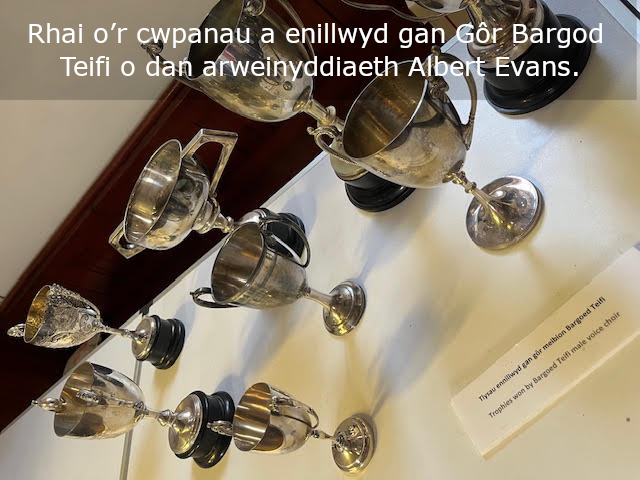
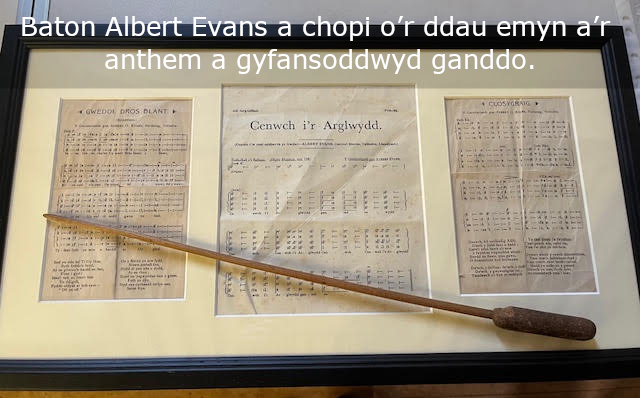
Under his leadership the choir enjoyed countless successes. We are delighted that Eirlys Griffin, Albert Evans' granddaughter, is with us today and has presented Albert's conductor's baton, together with several of the trophies won during his lifetime, to Stori Fawr Dre-fach Felindre. The long-term intention is to display these treasures in a glass cabinet at Penboyr School.
.jpg)
.jpg)
It is also worth remembering that Albert Evans founded the Dre-fach Felindre Silver Band, which played an important part in local life for many years. Many of us will remember the band performing at carnivals and other community events.
He also formed several singing parties. During the Second World War, one of these—the Octet—performed over 400 times to raise funds for servicemen.
Albert Evans served as choirmaster and organist at Closygraig Chapel from 1919 until his death in 1955. At one time he even led a small orchestra at the chapel.
He composed two hymn tunes, Closygraig and Gwyneth, together with the anthem "Cenwch i'r Arglwydd" ("Sing unto the Lord").
As a baritone he was awarded a certificate by the London College of Music, and in 1931 he was admitted to the Gorsedd of the Bards. Throughout his life he adjudicated at eisteddfodau and conducted Cymanfaoedd Canu across Wales.
Albert Evans came from Perthiteg, Cwmhiraeth, and died on 16 March 1955, aged sixty-five.
.jpg)
I attended his funeral, and what I remember most vividly is Bargod Teifi Male Voice Choir singing "Y Delyn Aur" outside his home, Central Stores, before the procession made its way to St Barnabas Churchyard.
Once again, Bargod Teifi Male Voice Choir erected a special memorial, which still stands today, although parts of it have weathered with time. It takes the form of an open marble music book, complete with a musical score across the top of its pages and the inscription:
"Ni fydd diwedd fyth ar sŵn y delyn aur."
"The sound of the golden harp shall never cease."
Here in St Barnabas Churchyard lie the two greatest musicians this district has ever produced. It is entirely fitting that we should gather for an afternoon such as this to remember them.
May the memory of Daniel Jenkins and Albert Evans long endure.
Click on these links to read more about Daniel Jenkins and Albert Evans.
Photographs from the Afternoon of remembrance 2026, click on the photos to expand.